My Role
Sole owner: research, synthesis, framework design, socialisation, and operationalisation.
Team
Lifecycle, PMM, Growth, Customer Education, Product Design, and Senior Directors.
Methods
Literature review, research synthesis, workshop facilitation, and guidelines writing.
3 teams. 3 user segments. No shared language for any of them
Contentquare serves distinct user segments: SMB, Mid-Market, and Enterprise users — each with different needs, vocabulary, and value drivers. As different companies merged, as well as their user base, and the product moved toward a self-serve model, the gaps became critical: we were working on upselling to Mid Market users without really understanding them, and this was branching out.
Lifecycle was writing emails without knowing what Enterprise users cared about. PMM was positioning features without knowing how SMB users thought about them. Every team was solving the same communication problem independently, and getting it wrong in different ways. There was no single source of truth for how to talk to our users.
Why this was a content design problem, not a marketing one
This wasn't about brand voice or campaign tone. It was about information design: what does each segment need to know, at what moment, in what order, and why? That's a content architecture question, and no one had answered it systematically.
I identified the gap, owned the solution, and drove adoption across the company
This project was entirely self-initiated. No one asked me to do this: I identified the need, made the case, and executed it from research through to operationalization.
I Led
- Problem identification and project scoping
- Literature review across all existing research
- Canvas design and synthesis
- Workshop and presentation delivery
- Paywall guidelines writing
- Ongoing maintenance and socialization
Team Contributed
- Existing research inputs from Data and Research
- Feedback on canvas drafts from PMM and Lifecycle
- Application in email programs by Lifecycle Marketing
- Integration into design work by Product Design
A literature review across all existing research: synthesized into one usable artefact
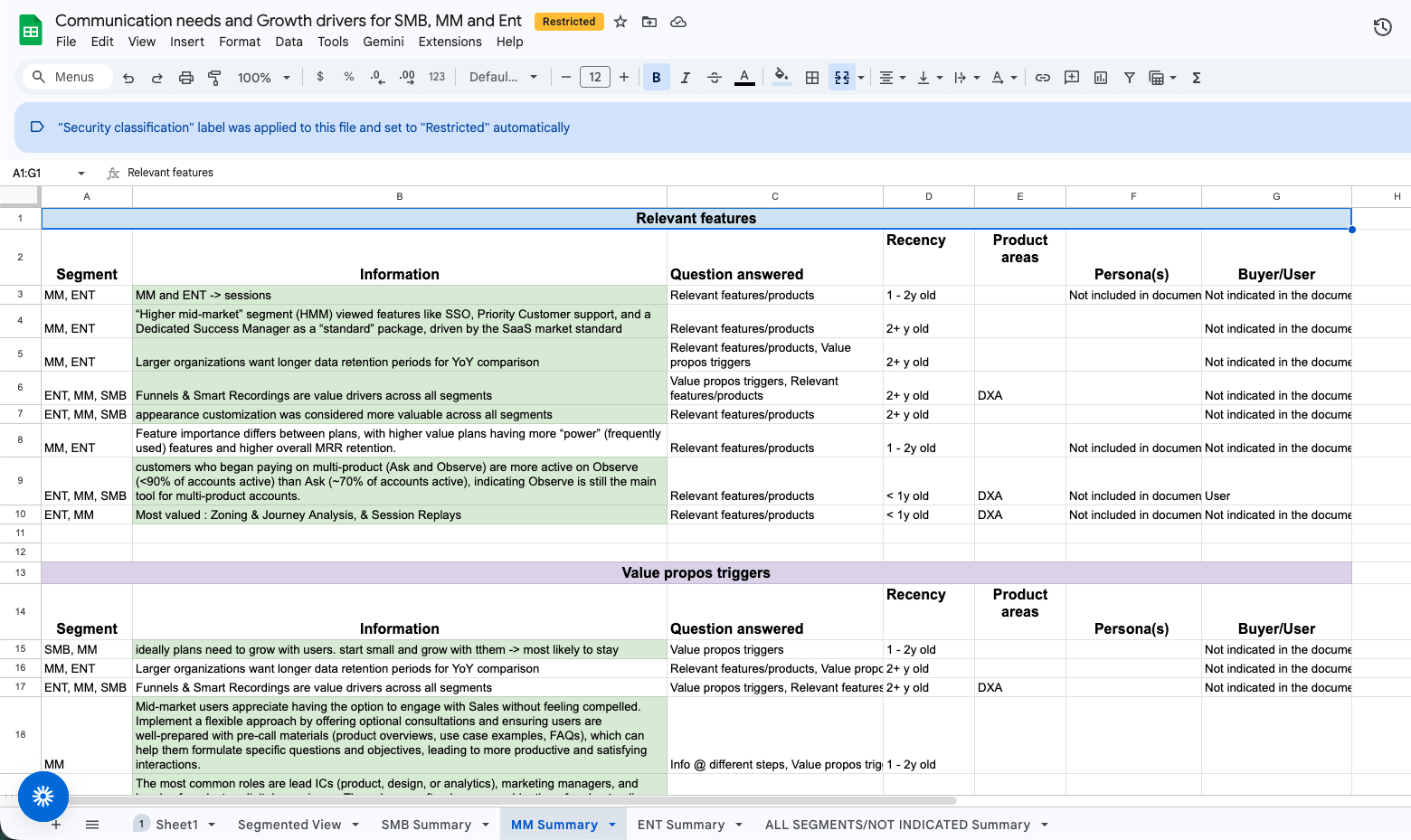
I started by pulling everything we already knew: customer research, data reports, Sales call notes, user interviews, NPS surveys, and product analytics. The question I was trying to answer: what does each segment actually need to know, and what do they value most?
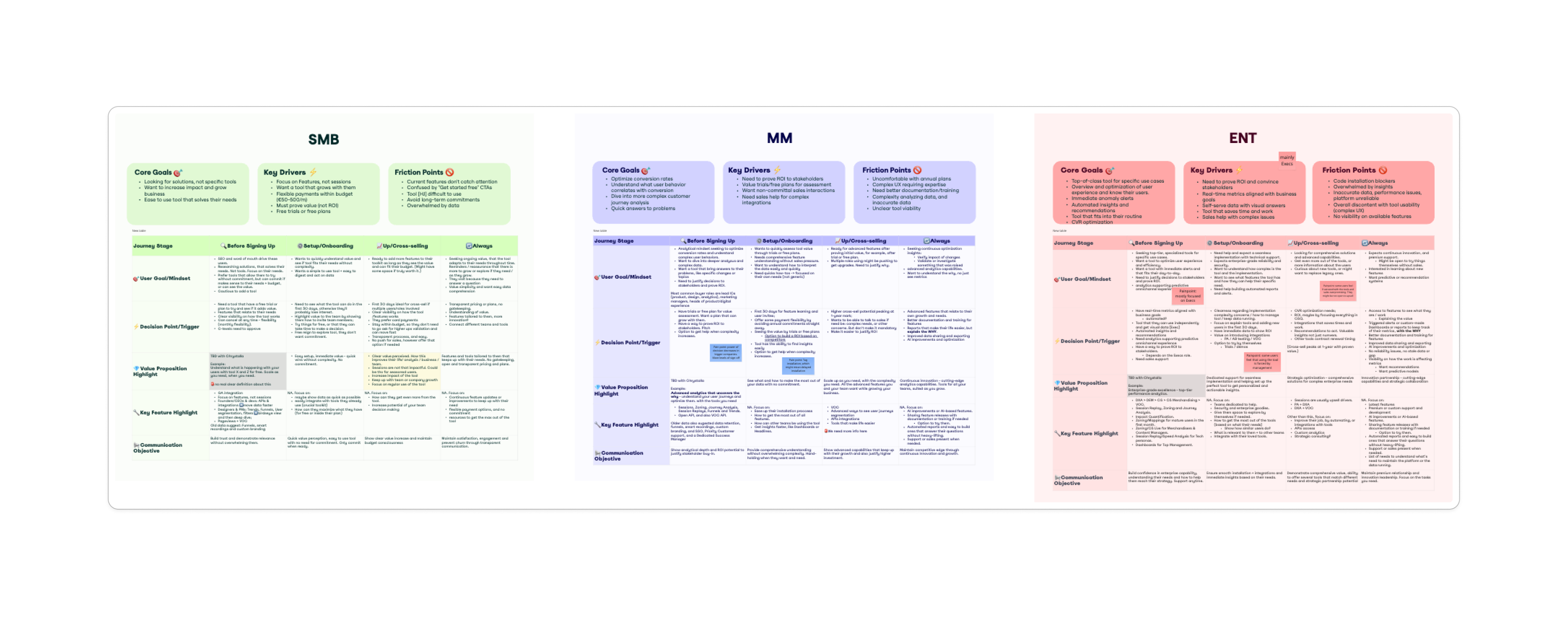
The output was a Segment Communication Canvas — a single document that captured, for each of our four segments, the key differences in their context, the features they valued most, their primary value propositions, and what to communicate at each stage of the journey.
Key design decision
Make it a working tool, not a research document. Most research outputs at this company lived in Confluence and were never read again. I designed the Canvas to be referenced mid-project — scannable, visual, and structured around the questions teams actually ask: "what should I say to an Enterprise user here?" rather than "tell me everything about Enterprise users."
| Step 1: |
Audit all existing research. Pulled customer research, data reports, Sales notes, and NPS surveys across all four segments. Identified what we knew, what we assumed, and what was missing. Outcome: research inventory and gap map |
|---|---|
| Step 2: |
Define the key questions teams need answered. Ran working sessions with Lifecycle, PMM, and Growth line teams to understand what communication decisions they were making without good information. Used this to shape the Canvas structure. Outcome: Canvas framework and dimensions |
| Step 3: |
Synthesize and build. Mapped all research to the Canvas framework. For each segment: context, top features, value propositions, what to say at each journey stage, and what to avoid. Outcome: v1 Segment Communication Canvas |
| Step 4: |
Socialize across the company. Ran workshops and presentations for Directors, Lifecycle, PMM, and Growth teams. Made it accessible in the design system and linked it from active project Miros. Outcome: line-wide adoption |
From research artefact to reusable content infrastructure
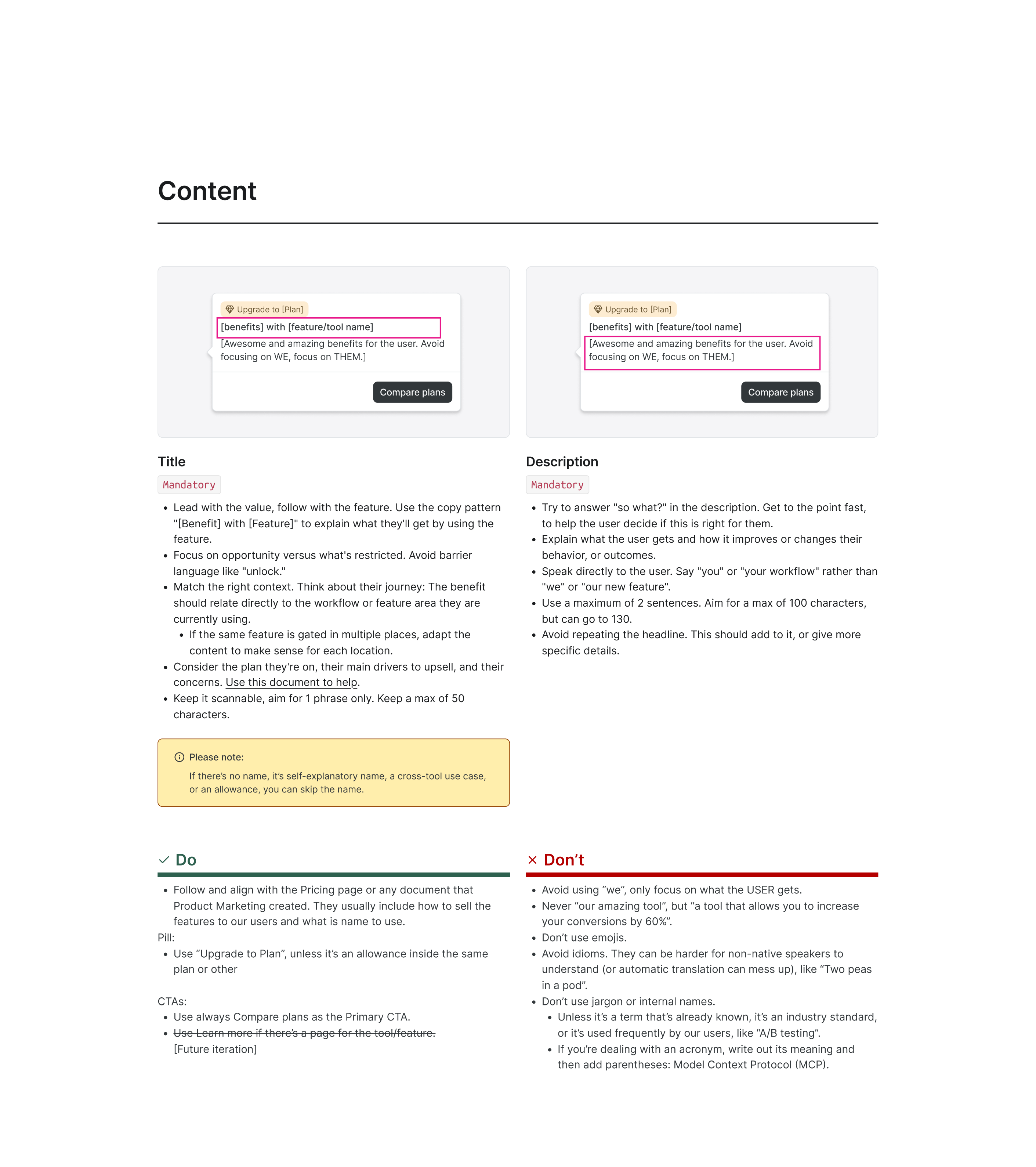
The Canvas answered "what to say." H2 was about making it easy for teams to say it without needing me in the room every time. I developed paywall guidelines for the monetization toolkit: segment-specific copy structures, content snippets, and decision rules for when to use each value proposition.
These gave Product and Design teams everything they needed to write high-quality paywall content independently.
Why guidelines, not a template?
Templates get misapplied. Guidelines build judgment. A template tells you what to write. A guideline tells you why, and what to do when the template doesn't fit. At a company that ships packaging changes constantly, teams needed the reasoning, not just the output. Guidelines scale; templates create dependency.
Four teams adopted it (in ways I didn't plan for)
The most meaningful signal of a useful framework isn't adoption you drive, it's adoption that happens without you.
Lifecycle Marketing
Used as the basis for all onboarding email programs
Lifecycle used the Canvas to build personalized email sequences for each segment. They now link to it or include screenshots in every Miro brainstorm they run with me.
Product Design (Growth)
Referenced in every monetization and paywall project
The Product Designer from Expansion started including Canvas references in design briefs and I used it to ground decisions in Tiger Team discussions with Directors and CMO.
Onboarding (all segments)
Defined narrative and prioritization of 15+ flows
I used the Canvas to determine what to surface first in Pro/ENT onboarding, and what language to use for SMB and Growth plan users encountering complex CSQ features for the first time.
Tiger Team (Pricing Page)
Shaped experiment prioritization and feature ranking
In a cross-department team with CMO and Senior Directors, I used Canvas data to argue for specific feature rankings and push back on decisions that didn’t match what segments actually needed.
Infrastructure that compounds: each team's results build on the same foundation
These results didn't come from a single project, they came from the same underlying infrastructure being applied across different contexts.
What I'd do differently, and what's next
What I'd do differently
Build in a maintenance process from day one. The Canvas is only valuable if it reflects current reality, however segments and the company evolve. I'd establish a quarterly review cadence with PMM and Data from the start.
What the next step would be
Extend the framework beyond Growth into adjacent areas. The Canvas was built for Growth motions but the segment logic applies across the product. The next version should be a company-wide content standard, not a Growth-line tool.